

- HOME
- Technology & Solutions Case Studies
- Sekidai Kogyo Co., Ltd.
Case Studies
—Why Okuma was chosen
Precision 5-axis machining of difficult-to-cut materials and complex shapes
Lead times reduced by 50%, strengthening ability to meet short delivery dates
Sekidai Kogyo Co., Ltd.
- Industry
- Machining of complex-shaped parts from difficult-to-cut materials
Reason for Installation
In response to new orders, we aimed to enhance process integration for large workpieces and establish a more stable production system.
Our company specializes in doing high-mix, low-volume precision machining for a variety of industries, primarily for motorcycle and automotive, as well as semiconductor manufacturing equipment and medical devices. One of our key strengths is our ability to do precision machining of difficult-to-cut materials such as Inconel and titanium.
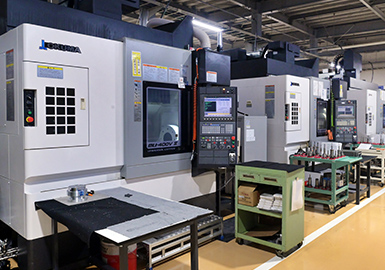
Since 2003, we have strived to do process-intensive machining using 5-axis machining centers and multitasking machines. However, we started to receive orders for large workpieces that were difficult to handle with our existing equipment. There was an urgent need to add a large 5-axis machining center to establish a stable production system that could do precision machining within short delivery deadlines.
The Okuma machine selected to solve these challenges
Decisive factor for installation
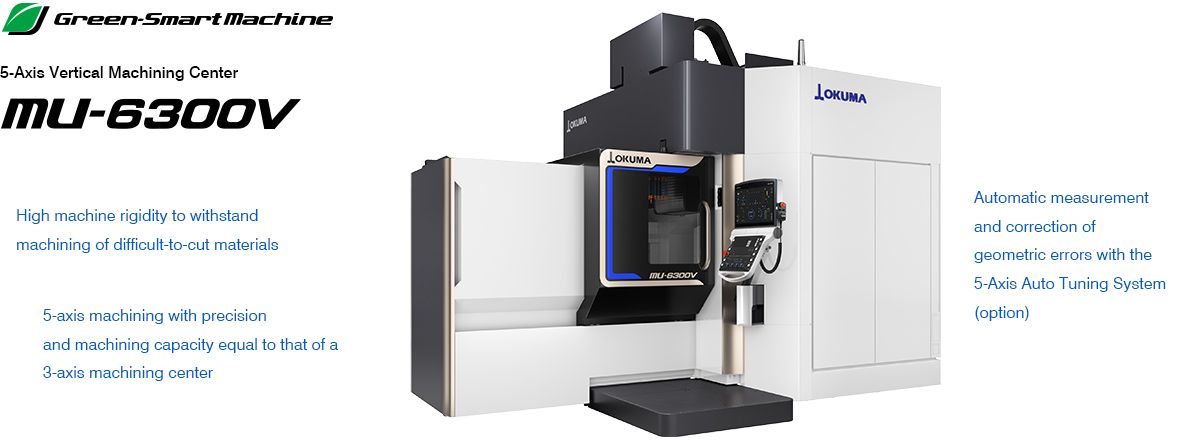
Machine rigidity for machining difficult-to-cut materials, ensuring stable precision
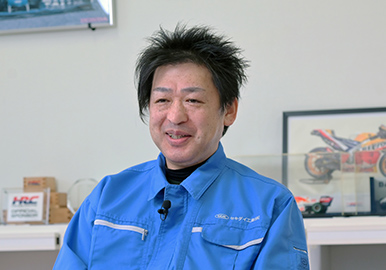
The large automotive suspension components we needed to produce required to be machined from multiple directions and demanded precision accuracy with tolerances of 10-20 μm. We had long utilized the MU-V series (5-axis machining center) and highly valued its excellent accuracy stability and capability to machine difficult-to-cut materials.
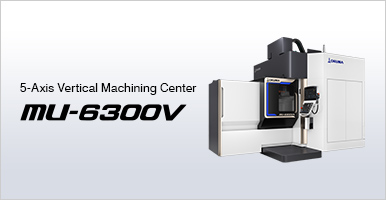
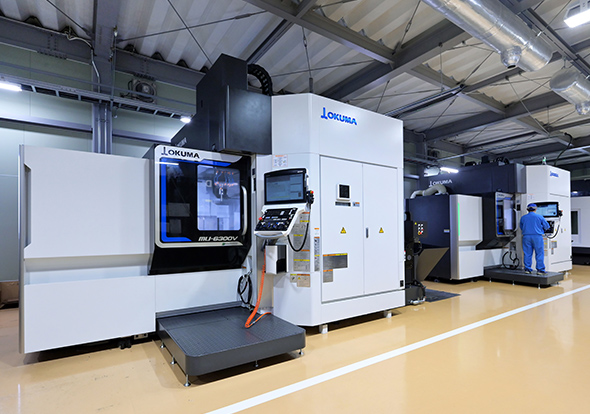
To achieve short lead times under strict quality control, we chose the MU-6300V as a candidate for our next machine, as it enables highly efficient machining while maintaining high precision over extended periods of operations.
Previously, machining was divided into four processes using existing vertical machining centers. However, with the addition of the MU-6300V, it is now possible to consolidate the machining stages into two processes.
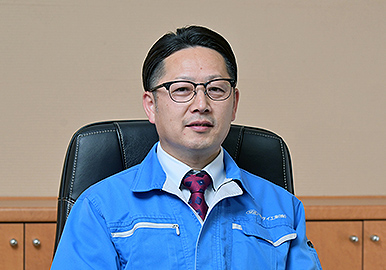
In addition to making lead times shorter, we believe it offers significant cost-effectiveness by reducing operator workload and lowering fixture costs.(Masayuki Okabe)
Effectiveness of machine after installation
Lead time reduced by 50% through process integration. Workload required for quality control and costs for fiixtures were cut in half.
Previously, repeated clamping and unclamping across multiple processes caused distortion of the workpiece and dimensional errors, making it difficult to maintain stable machining accuracy. By consolidating the processes into just two stages, we were able to eliminate the need for measurement and corrective machining at each step, which ultimately led to a 50% reduction in overall lead time. As the number of inspections was reduced from four to two, the workload required for accuracy control at each stage has been significantly reduced.
Typically, as the number of processes increases, so does the number of fixtures required. This results in increase in costs for manufacturing fixtures. However, by consolidating the processes, we have been able to reduce fixture costs by nearly half.
As productivity has improved, we’ve gained additional capacity that enables us to machine other parts, which in turn has contributed to improving the overall utilization rate of the factory.
Machine rigidity that enables machining of difficult-to-cut materials, and dimensional stability ensured by the Thermo-Friendly Concept
With the MU-6300V, we also perform precision machining of difficult-to-cut materials such as titanium, Inconel, and stainless steel. These materials require a long time to machine and impose heavy loads on the tools. Maintaining accuracy and managing tool life are general issues. The MU-6300V achieves exceptional dimensional stability through the synergistic effects of its high machine rigidity—which suppresses spindle vibration during machining—and Okuma’s intelligent technology, the Thermo-Friendly Concept. This enables stable, high-precision machining even during long continuous operations exceeding 20 hours and in environments where temperatures fluctuate between morning and evening.(Masayuki Okabe)
High surface quality machining with 5-Axis Auto Tuning System Ⅱ (option)
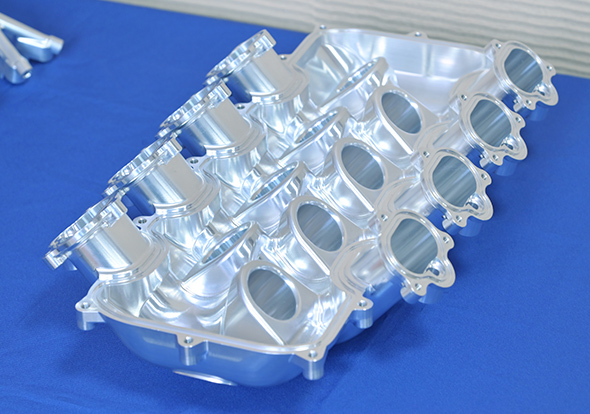
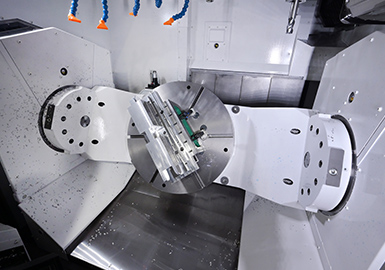
To machine cylindrical workpieces of intake systems, simultaneous 5-axis machining is performed by cutting from both sides and connecting at the center. However, to maintain machining accuracy, it is important to compensate for various geometric errors.
In 5-axis machining, geometric errors such as misalignment of rotary axes can affect machining accuracy. To address this, we utilize the 5-Axis Auto Tuning System Ⅱ, which automatically compensates these errors in a short amount of time.
What impressed us most was that the joints between machining passes were almost invisible after simultaneous 5-axis machining of workpieces were finished. This was achieved by tuning the 5-axis machining accuracy to its optimal state with the 5-Axis Auto Tuning System Ⅱ and maintaining stable accuracy over long operations with the Thermo-Friendly Concept. We were impressed by the high level of precision made possible.
Even young operators feel ease-of-use and have a sense of reliability during machining
Generally, 5-axis machining centers are difficult to operate because they include both linear axes and rotary axes. Because of this, they are often handled by experienced operators.
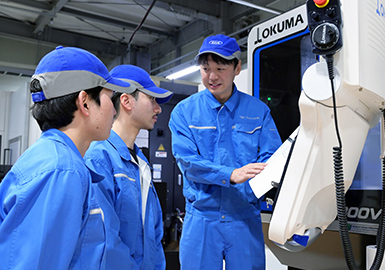
However, we utilize Okuma's NC School to help less experienced young employees learn the entire 5-axis machining process from an early stage of their careers.
This is our policy to spread awareness throughout our company that “5-axis machining is our standard.”
This initiative is supported by the user-friendly operability of the MU-V series. It is easy to operate for beginners, has excellent in-machine visibility, and the Collision Avoidance System prevents in-machine collisions.
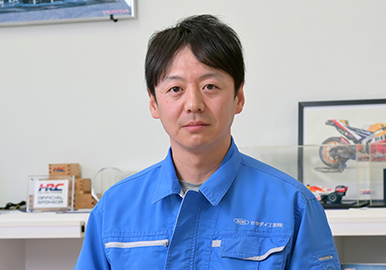
The ability to check the movement of the workpiece and tools in 3D in advance is an important factor that enhances confidence on the shop floor.(Yoshio Sekine)
*NC School: A course with classroom training and actual machine operation to learn basics of machine operation
Outlook for the future
We would like to consider automating large-part machining based on the benefits gained from installing the MU-6300V.
Installation of the MU-6300V has had substantial effects, including improvement of productivity and reduction of operator workload. Taking into account the benefits of process integration, we feel that we have reached a stage where we can realistically consider the automation of large-part machining.
In the future, we intend to examine which automation solutions are best suited for our company and utilize them to expand our capabilites into higher value-added machining, as well as entering new fields such as the aerospace industry.(Tadao Kishinami)
Customer Information
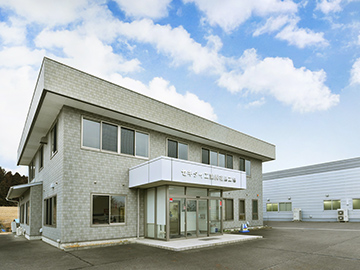
Sekidai Kogyo Co., Ltd.
(Ishikawa-cho, Fukushima Prefecture)
- Website
- https://www.sekidai.co.jp/
The company was established in Ota Ward, Tokyo, in 1964 and began machining low voltage electrical components. Its Fukushima Plant opened in 1987, establishing a two-site production structure with its headquarters facility. The company also expanded its business into the production of automotive and motorcycle parts, demonstrating its technical capabilities through the machining of prototype parts for both commercial and racing vehicles. In particular, the company earned a strong reputation for the precision machining of difficult-to-cut materials and complex-shaped components—skills developed through racing parts—along with their ability to meet short lead times, which drove the company's business expansion. In 2012, Sekidai Kogyo Co., Ltd. obtained ISO9001 certification. In recent years, orders for semiconductors, medical equipment, robots, drones, and aerospace-related parts have been increasing.